
50-State Survey: Late Notice and the Prejudice Requirement
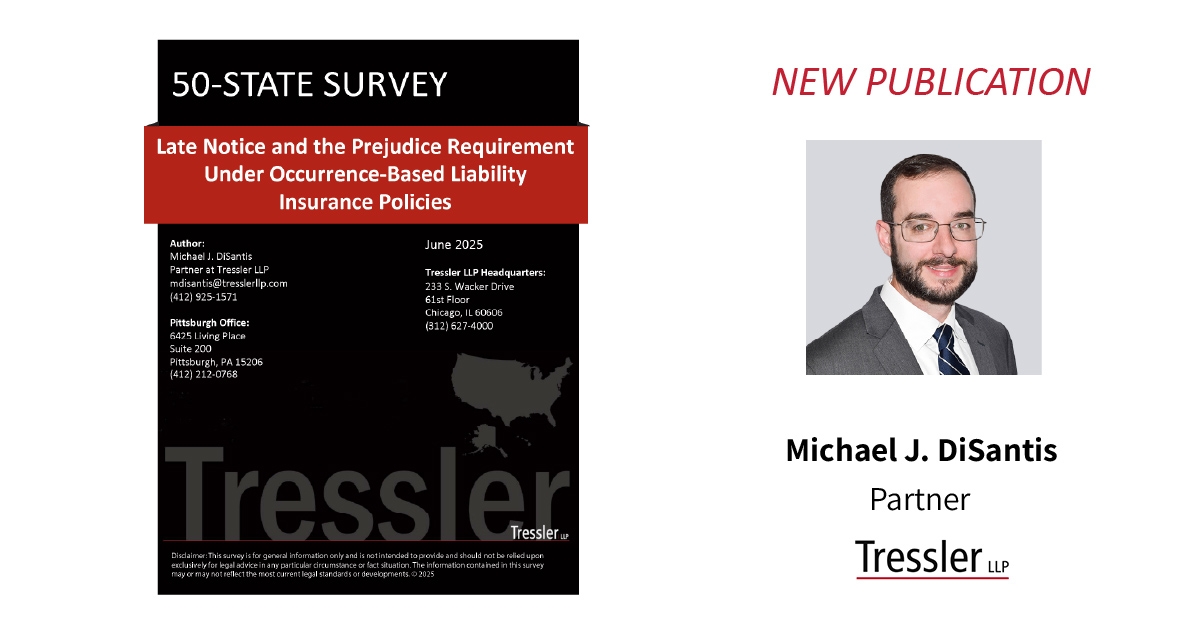
Tressler is proud to announce Michael DiSantis’ new publication “50-State Survey: Late Notice and the Prejudice Requirement Under Occurrence-Based Liability Insurance Policies”.
To receive a complimentary copy of this publication, please contact Michael DiSantis at mdisantis@tresslerllp.com.
Preview of Introduction:
This survey addresses whether an insurer may deny coverage based on an insured’s failure to comply with the notice condition in an occurrence-based liability insurance policy in the absence of resulting prejudice. Most states have adopted the “notice-prejudice” rule, holding an insurer may not deny coverage based on late notice if there is no resulting prejudice. Those states that have adopted the notice-prejudice rule have reached varying conclusions as to whether the insurer or the policyholder bears the burden of proving prejudice (or a lack of prejudice), and the standard for meeting that burden. In contrast, some states adhere to the “common law” rule holding an insurer may deny coverage even in the absence of prejudice, with some of those courts finding prejudice is relevant to whether the insured breached the notice condition and others finding prejudice is irrelevant entirely.
About Michael DiSantis
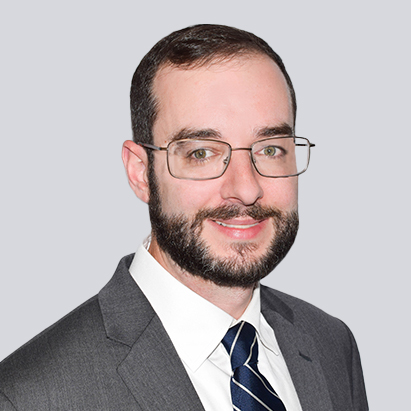
Michael DiSantis is a partner in the Insurance Services and Litigation Practice Groups and focuses his practice in the areas of insurance coverage analysis and insurance coverage litigation. In his practice, Michael assists insurance companies in evaluating complex coverage issues and disputes, litigating declaratory judgment actions, and defending allegations of breach of contract and extracontractual liability in litigated matters.
Michael has evaluated coverage issues arising under a wide variety of coverages and substantive areas of law, including traditional exposures like toxic tort, environmental, and construction defect, and emerging exposures such as hotel trafficking and social media claims. He has extensive experience in evaluating issues arising out of commercial general liability and excess coverage, and is also experienced in evaluating first-party, environmental impairment liability, and directors & officers insurance policies. Michael has successfully litigated disputes arising out of “personal and advertising injury” coverage and has represented clients in complex disputes arising from environmental claims under historical commercial general liability and modern environmental impairment liability policies.
Michael has represented insurance companies in litigated matters in state and federal courts throughout the country, including the prosecution and defense of declaratory judgment actions and the defense of lawsuits alleging extracontractual liability. He regularly provides legal assessments to clients evaluating, investigating, and handling claims that present excess exposures, and provides clients with advice as to how to respond to policy limit demands. Michael has participated in many mediations in contexts ranging from simple coverage disputes to mass tort to catastrophic losses. Click here to read Michael’s full attorney biography.