
Airshows: The Most Regulated Spectator Sport in America
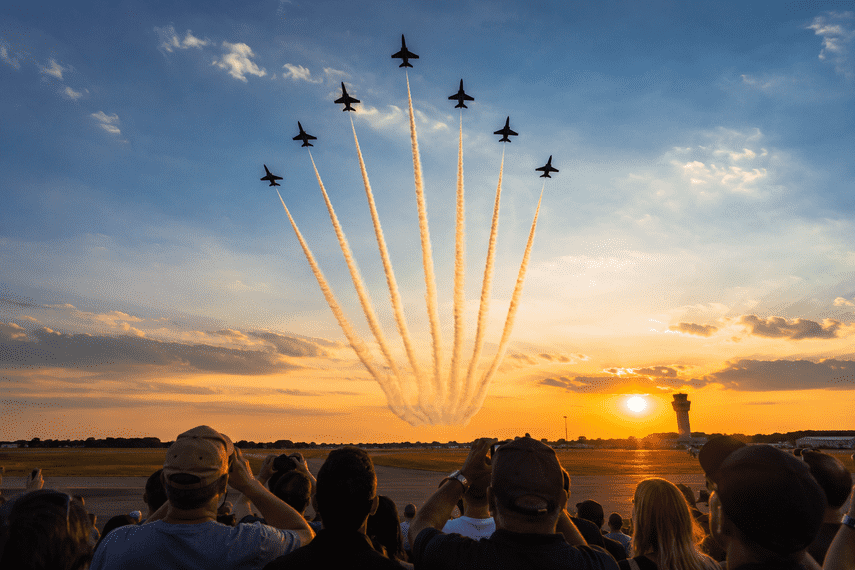
Summer is airshow season.
Across the United States, spectators flock to events ranging from EAA AirVenture Oshkosh and Sun ‘n Fun Aerospace Expo to military open houses, warbird exhibitions, and regional aviation festivals. For those looking to find an event nearby, organizations such as the Commemorative Air Force Events Calendar maintain extensive listings of airshows and aviation events throughout the country.
Among these events, Oshkosh stands apart. EAA AirVenture routinely attracts hundreds of thousands of attendees and more than 10,000 aircraft, making it the largest aviation gathering in the world.
What spectators rarely see is the legal and regulatory framework that makes these events possible. In reality, airshows may be among the most heavily regulated spectator events in the United States. Long before the first aircraft takes to the sky, organizers, airport operators, pilots, insurers, emergency responders, and federal regulators have already spent months coordinating approvals, safety plans, operational restrictions, and contingency procedures.
Airshows are often viewed as celebrations of aviation. They are equally demonstrations of regulatory coordination. Indeed, many of the flights, maneuvers, and formations that define a modern airshow would be prohibited under the Federal Aviation Regulations absent specific FAA waivers and approvals. The modern airshow exists because of regulation, not despite it.
More Than an Aviation Event
Unlike most public gatherings, airshows involve aircraft operating in close proximity to spectators. That reality introduces risks not present at a football game, concert, or convention.
Federal aviation regulations generally prohibit many of the activities spectators come to see. Aerobatic flight, formation demonstrations, low-altitude passes, and specialized maneuvering often require FAA approval that would be unnecessary or impermissible during ordinary flight operations.
For example, 14 C.F.R. § 91.303 generally prohibits aerobatic flight over congested areas, over open-air assemblies of persons, and below 1,500 feet above the surface. Likewise, 14 C.F.R. § 91.111 (“Operating Near Other Aircraft”) governs formation flight, while 14 C.F.R. § 91.905 identifies numerous operating rules that may be waived for aviation events, including rules governing formation flight, aircraft speed, minimum altitudes, and aerobatic flight.
To accommodate these events, the FAA administers its National Aviation Events Program, which governs aviation-event waivers, air boss qualifications, Statements of Aerobatic Competency (“SAC” cards), safety briefings, emergency planning, temporary flight restrictions, and risk-management procedures. The FAA’s guidance includes specialized requirements for airshows, air races, military demonstrations, parachute operations, and formation flying.
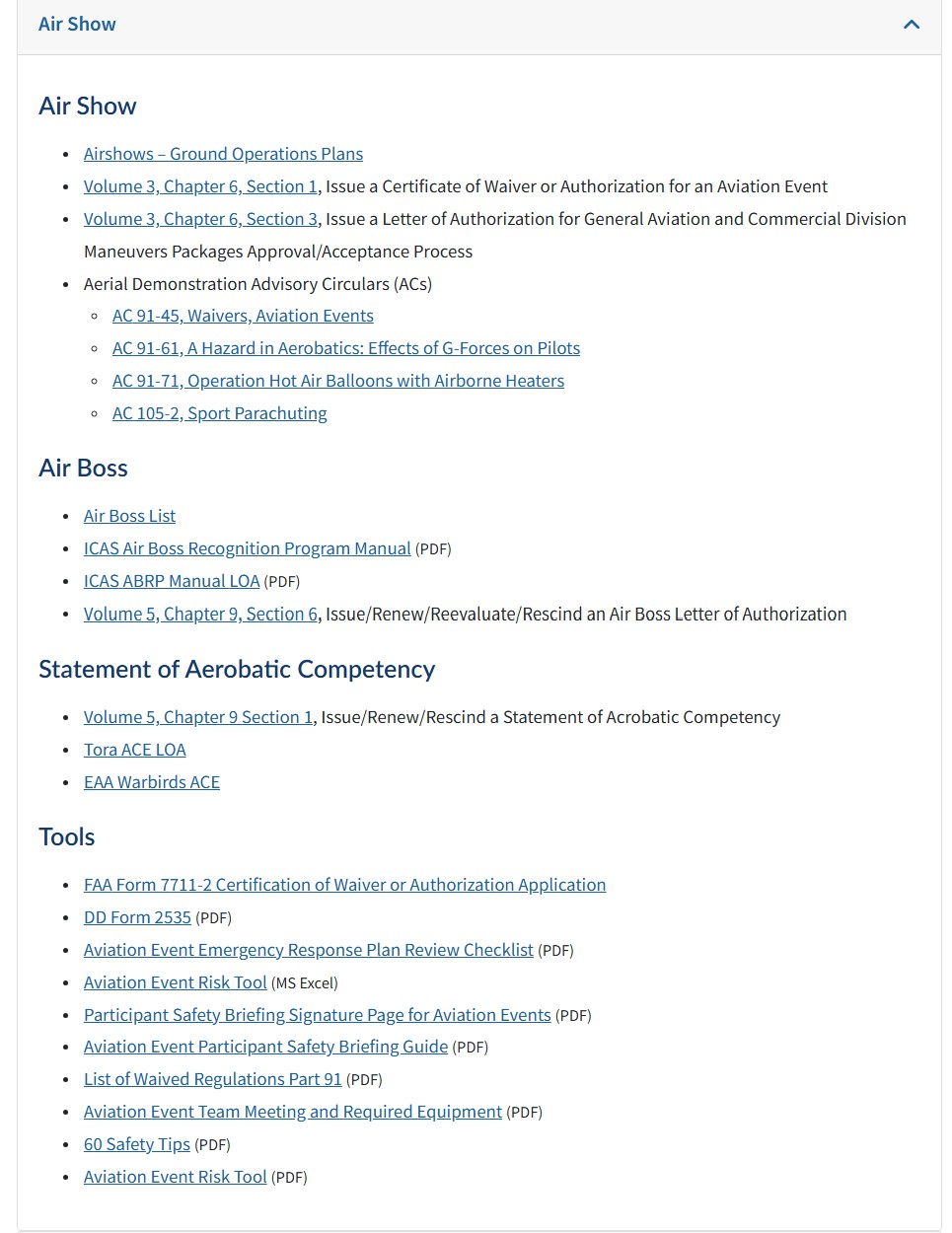
At certificated airports, FAA approval extends beyond flight operations. Airshows require ground operations plans, emergency response coordination, and review by multiple FAA offices before a waiver is issued. The result is a temporary regulatory environment tailored to a specific event, location, and set of performers.
The Invisible Infrastructure
An airshow audience sees aircraft. Regulators see something very different.
Before approving a major event, planners evaluate crowd locations, aerobatic boxes, emergency access routes, aircraft parking areas, performer qualifications, communications protocols, and local airspace considerations. Organizers coordinate with air traffic control, airport management, law enforcement, fire and rescue agencies, military participants, and insurers.
Many performers must demonstrate specialized qualifications beyond those required for ordinary pilot certification. At the center of many events is the air boss—the individual responsible for coordinating and managing flight operations throughout the show. The result is a layered system in which federal regulations, FAA approvals, industry standards, airport requirements, insurance considerations, and operational procedures all function simultaneously.
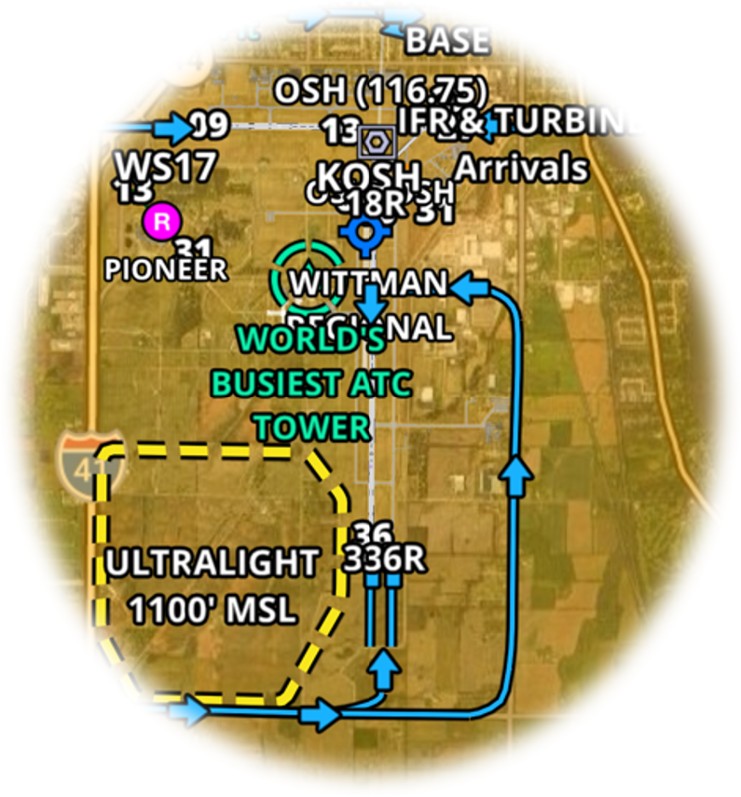
AirVenture Oshkosh offers a ready example. Every summer, the FAA publishes detailed arrival and departure procedures governing thousands of aircraft converging on a single airport. What appears to be an enormous gathering of airplanes is, in reality, a carefully choreographed exercise in airspace management. The public rarely notices these restrictions, yet they are essential to safe operations.
When Things Go Wrong
The modern airshow safety record reflects decades of regulatory refinement and operational experience. Nevertheless, recent accident investigations demonstrate why planning and oversight remain critical.
In December 2024, the National Transportation Safety Board (“NTSB”) issued its final report concerning the 2022 Wings Over Dallas collision involving a Boeing B-17 Flying Fortress and a Bell P-63 Kingcobra. Significantly, the investigation focused on deficiencies in pre-briefing, aircraft-separation planning, operational procedures, and oversight mechanisms.
In Corradi v. Old United Casualty Co., 2015 WL 8489966 (E.D. Va. Dec. 8, 2015), the court addressed a coverage dispute arising from the crash of a 1942 Waco UPF-7 during an airshow. The aircraft owner sought coverage under a policy containing an Airshow Extension Endorsement. The court nevertheless enforced the policy’s approved-pilot warranty, holding that the policy “only covers the operation of the Aircraft by ‘Approved Pilots’” and that the airshow endorsement did not alter that requirement. Because the aircraft was being flown by a pilot who was not listed as an approved pilot, coverage was barred notwithstanding the aircraft’s participation in an FAA-approved airshow.
Nearly a decade later, in Volz v. Bruce, 2024 WL 4708011 (E.D. Wis. Nov. 6, 2024), a federal court sitting in Wisconsin addressed claims arising from a fatal collision during EAA AirVenture Oshkosh. According to the complaint, a gyrocopter pilot performed prohibited 360-degree maneuvers despite repeated safety briefings before colliding with a helicopter, killing two occupants. Plaintiffs sued the aircraft manufacturer and related entities under agency and joint-venture theories. The court held that the manufacturer’s repeated attendance at Oshkosh, operation of exhibit booths, and marketing activities directed toward the American market were sufficient to support personal jurisdiction in Wisconsin. The court further concluded that the alleged injuries arose from the defendants’ activities at AirVenture itself.
These cases, decided nearly ten years apart and arising from very different circumstances, illustrate the breadth of legal issues airshows can generate. What begins as a weekend aviation event can quickly implicate insurance coverage, pilot qualifications, regulatory compliance, agency relationships, product manufacturers, venue operators, and complex jurisdictional questions.
The Next Generation of Airshows
Airshows have long provided the public’s first glimpse of aviation’s future.
A century ago, spectators watched barnstormers and military aircraft demonstrate capabilities that would eventually become commonplace. Later generations were introduced to jet aircraft, composite airframes, glass cockpits, and advanced avionics. Today’s airshows continue to serve that function. Alongside warbirds and aerobatic performers, attendees increasingly encounter electric aircraft, advanced air mobility concepts, unmanned aircraft systems, and autonomous technologies.
Many of the technologies that once seemed confined to science fiction—including beyond visual line of sight drone operations, advanced air mobility vehicles, and increasingly autonomous aircraft systems—are rapidly moving from concept to reality. The legal and regulatory questions surrounding those technologies are already being debated by the FAA, Congress, state legislatures, industry stakeholders, and courts.
In many respects, airshows serve as a bridge between innovation and public acceptance. They provide an opportunity for the public to see emerging technologies firsthand while allowing regulators, operators, manufacturers, and pilots to demonstrate how those technologies can be integrated safely into the national airspace system. That role may become increasingly important as aviation enters an era defined not only by pilots and aircraft, but also by automation, connectivity, advanced air mobility, and autonomous systems. The same regulatory principles that govern today’s airshows—risk assessment, operational discipline, layered safety protections, and public confidence—will likely shape tomorrow’s aviation landscape as well.
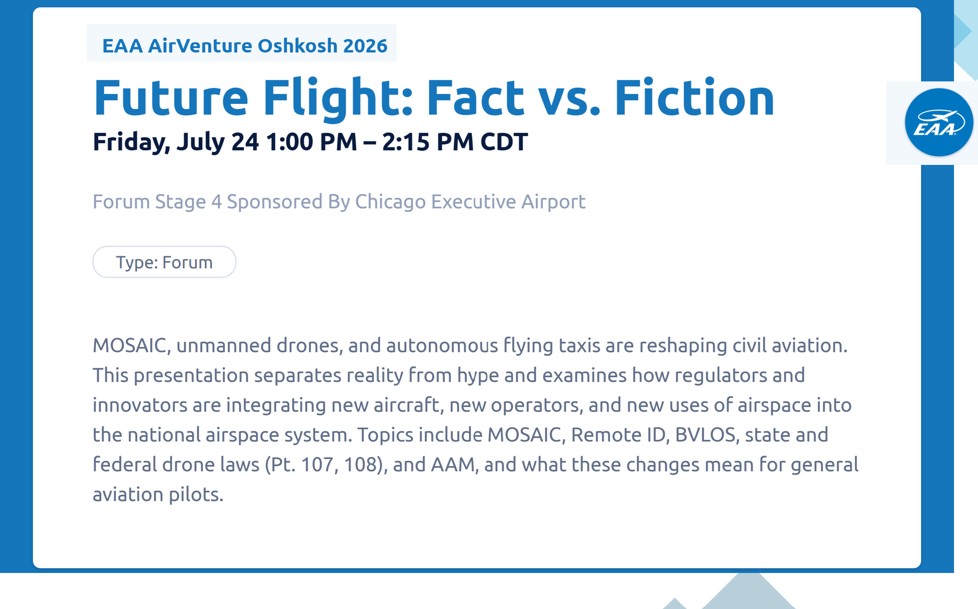
On Friday, July 24, Timothy Ravich will present Future Flight: Fact vs. Fiction at EAA AirVenture Oshkosh from 1:00–2:15 p.m. CDT, where he will examine how emerging technologies, including MOSAIC, unmanned drones, and autonomous flying taxis, are reshaping civil aviation.
For more information about this article, please contact Timothy M. Ravich at travich@tresslerllp.com.
About Timothy M. Ravich
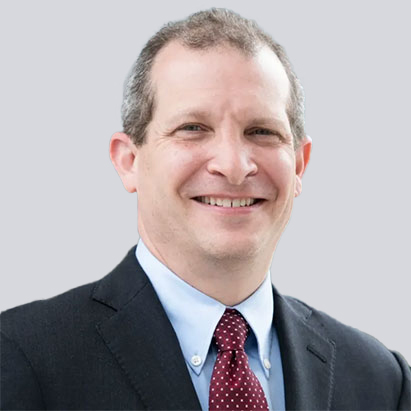
Timothy M. Ravich concentrates his practice in the areas of aviation, product, and general civil litigation. Recognized as one of only 50 lawyers qualified as a Board-Certified Expert in the area of aviation law, Tim focuses on traditional areas of aviation litigation, including product liability and airline defense, and pioneering areas such as unmanned aerial vehicles (drones) and advanced air mobility. Click here to read Tim’s full attorney biography.