
Honoring the Historic Women of Aviation Law

In 1985, Air India announced that it operated an all-women crew flight in the jet age. American Airlines followed in 1986, and well into the 2010s. Airlines were still publicizing internal firsts as when El Al, albeit as a consequence of a scheduled change, announced its first-ever all-woman cockpit in January 2016 on a flight to Cyprus. During Women’s History Month 2026, these important milestones present an opportunity to look forward in aviation by looking back through a legal lens.
The 1960s-era case of Cooper v. Delta Air Lines, Inc., 274 F. Supp. 781 (E.D. La. 1967), offers an extreme reference point (at least by today’s standards). There, Eulalie E. Cooper signed a one-page contract titled “Employment Termination in the Event of Marriage (Stewardess),” in which she certified she had “never been married” and agreed that she would “terminate automatically and voluntarily” her employment before she entered “a contract of marriage.” Cooper married in October 1964; however, when Delta learned of the marriage, it demanded her resignation. She declined, and the airline fired her.
Cooper went to the Equal Employment Opportunity Commission (“EEOC”) and then filed a federal lawsuit claiming the airline’s policy was unlawful discrimination. Delta did not dispute that it applied this “single woman rule” only to stewardesses. A federal judge in Louisiana ruled that U.S. law (specifically, Title VII of the Civil Rights Act of 1964) barred discrimination because of “race, color, religion, sex, or national origin,” but did not bar discrimination “due to one’s marital status,” which the court treated as “the issue in this case.”
The Court acknowledged that Congress had branded almost every employment practice that discriminated against an individual because of race, color, religion, sex, or national origin. But, the trial judge observed, “Congress did not outlaw Delta’s discretion to hire only stewardesses who are single and young, 20 to 26 years of age, average height, 5’2″ to 5’6″, slim, not more than 135 pounds, educated at least two years of college.” What is more, the court received testimony that the airline in fact required that its stewardesses must have “good complexions,” “neat[ness],” “attract[iveness],” and “good” “family background” and “moral character,” and the court accepted the airline’s claim that “single women” were better suited than “married women” because of “better passenger acceptance,” easier schedule changes, and “less likelihood of pregnancy.” [A substantial number of stewardesses continued their aviation careers by concealing their married status. See, e.g., Neal v. American Airlines, Inc., EEOC, Jun. 20, 1968).]
Several other cases from the same era treated marriage restrictions as “marriage” classifications rather than sex discrimination. Others analyzed whether particular rules could be justified as job-related, and whether a facially neutral rationale masked a practice imposed only on women in the cabin workforce. See, e.g., Laffey v. Northwest Airlines, Inc., 567 F.2d 429 (D.D.C. 1976); Stroud v. Delta Air Lines, 548 F.2d 356 (5th Cir. 1977); Sprogis v. United Air Lines, Inc., 444 F.2d 1194 (7th Cir. 1971). However framed, for a time, airlines wrote marital status into the conditions of employment for “stewardesses” and defended those conditions in litigation and administrative proceedings.
As one commentator opined, these policies did not endure as a function of airline business—no thanks to courts and legal proceedings:
Clearly, reason does not require that a stewardess remain single. Accordingly, the court’s failure to protect [Cooper] from the arbitrary restriction through use of the state’s unemployment compensation law is disturbing. But the particular issue has subsequently been mooted by developments on the federal side. The EEOC, disgruntled by the decision in Cooper v. Delta Air Lines, Inc., applied a previous rule against marriage-bans for women employees to stewardesses in the summer of 1968. Since that time, all major airlines have abandoned their restrictions pursuant to union negotiations. Mrs. Cooper’s case, pending on appeal, was dropped in November of 1968 when Delta rescinded its marriage ban. Outside the courts, in other words, reason prevailed and so did Mrs. Cooper.
Comment, Marital Restrictions on Stewardesses: Is This Any Way to Run an Airline?, 117 U. Pa. L. Rev. 616 (1969).
Fast forward nearly sixty years when the International Air Transport Association (“IATA”) published a 2024 report titled “Gender in Aviation: Celebrating Progress while Looking to the Future.” It describes an industry that remains “very segregated,” with cabin-crew work “heavily female-dominated” and the flight deck “largely male-dominated,” and further reports that women comprised 4.7% of pilots and 3.1% of aircraft maintenance engineers (with 21.1% of air traffic controllers), asking: “Are we moving fast enough to achieve true gender balance?”
FAA 2024 Active Civil Airmen Statistics
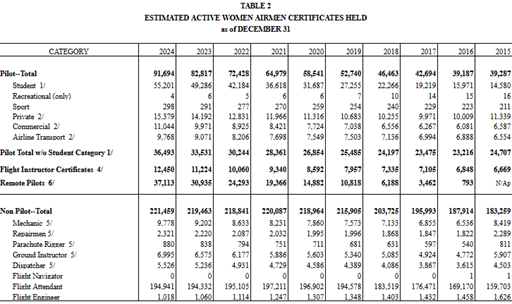
Placed next to IATA’s present-day framing, cases like Cooper provide a relevant comparison point. IATA describes global aviation as an industry that endures as “very segregated,” with cabin work heavily female-dominated and the flight deck largely male-dominated. That said, cases like Cooper and related commentary show workplace rules and job structures that were once written into employment practices and defended in litigation are not in place. (Cooper is still good law on the facts before that court: “Congress did not ban discrimination in employment due to one’s marital status and that is the issue in this case.”) In this sense, the legal record supplies a grounded way to see what the industry has changed, what it has dismantled, and what questions remain when the goal is not isolated “firsts,” but opportunities across aviation roles.
Today, the landscape is different in one important respect: women who want aviation careers now have mature institutions built to help them enter, stay, and lead.
- The International Aerospace Women’s Association (“IAWA”) exists to “cultivate and advance women leaders” through a global network, and it runs structured mentorship programming aimed at professional growth and advancement. (org).
- Women in Aviation International (“WAI”), which grew out of the first Women in Aviation Conference in 1990 and later became a nonprofit professional association, similarly centers networking, education, mentoring, and scholarships across the full range of aviation and aerospace roles—not just the flight deck. (org)
- And for pilots specifically, The Ninety-Nines—founded in 1929—remain a long-running backbone of peer support and scholarship opportunities, including the Amelia Earhart Memorial Scholarship Fund and a broader scholarship registry. (The Ninety-Nines, Inc.)
These kinds of pipelines matter because they are the opposite of the “single woman rule”: instead of writing limits into employment, they build ladders—training, mentorship, and professional community—so that “firsts” become normal, repeatable outcomes. That is the forward-looking work that fits Women’s History Month, and it echoes a much older reminder that progress is also a choice. As Abigail Adams urged John Adams on March 31, 1776: “Remember the Ladies, and be more generous, and favourable to them than your ancestors.”
About Timothy M. Ravich

Timothy M. Ravich concentrates his practice in the areas of aviation, product, and general civil litigation. Recognized as one of only 50 lawyers qualified as a Board-Certified Expert in the area of aviation law, Tim focuses on traditional areas of aviation litigation, including product liability and airline defense, and pioneering areas such as unmanned aerial vehicles (drones) and advanced air mobility. Click here to read Tim’s full attorney biography.