
U.S. Court of Appeals Rules on Meaning of Federal Law Against Interference with Airline Personnel

The public facing role of commercial airline flight attendants involves providing beverage and refreshment service and keeping the cabin environment moving smoothly at 36,000 feet. But behind that calm professionalism is a serious safety role—and a legal expectation that passengers will treat them with respect. When that trust breaks down, the consequences can reach far beyond bad behavior.
That is exactly what happened in United States v. Olvera, a federal case decided on October 7, 2025, and arising from the misbehavior of a passenger who secretly recorded a flight attendant on an American Airlines flight. His actions—caught on video by another crew member—left the attendant feeling trapped and violated inside a “metal tube, 36,000 feet in the air.” The case ended with a conviction for interfering with a flight crew, and on appeal, the United Stated Court of Appeals for the Eleventh Circuit made clear: a passenger does not have to physically assault or threaten a crew member to commit this crime—knowingly intimidating or disrupting them is enough.
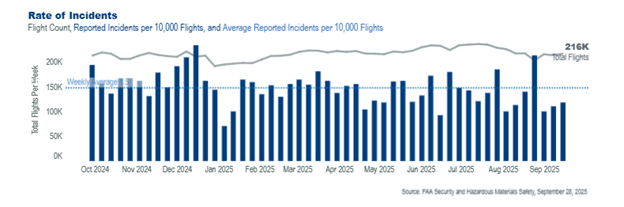
Interference with crew is far from an isolated problem, unfortunately. The International Air Transport Association (IATA) reports that one unruly passenger incident occurs for every 395 flights worldwide, with verbal abuse, harassment, and refusal to follow instructions among the most common issues. In the United States, the Federal Aviation Administration (FAA) still logs hundreds of interference cases each year, with potential fines up to $37,000 per violation and, in serious cases, federal criminal charges. These numbers highlight why courts continue to treat interference cases seriously: protecting flight crews means protecting everyone onboard.
“Stuck in a Metal Tube at 36,000 feet upon the Air”
On November 6, 2023, a federal agent, Billy Olvera, was on American Airlines Flight 232 from Dallas–Fort Worth to Miami. Flight attendant “A.G.” was assigned to the main cabin galley, where she set up beverage carts and served drinks. Her jump seat was in the back of the plane.
Before takeoff, A.G. learned that two federal agents, including Olvera, would be escorting a passenger. These agents are always seated in the last row, are armed, and usually introduce themselves to the cockpit, but Olvera and his partner did not. A.G. approached them about it before departure. Olvera had been assigned the middle seat (37E) but instead sat in the aisle seat (37D), placing the passenger he was escorting in the middle.
During the flight, A.G. interacted with Olvera several times, helping him connect to the plane’s WiFi and checking on it later. She noticed he kept one leg and shoulder in the aisle, which forced her to brush past him. He also kept looking over his shoulder toward the galley, which she initially thought was just to stay out of the way.
When beverage service began, Olvera asked for cookies. A.G. didn’t have any at that moment but promised to bring some later. On her next trip through the aisle, she saw that his phone was lying beside his thigh with the camera facing upward. When she returned, Olvera quietly called her over again, speaking so softly that she had to lean down. As she did, she saw his phone about an inch and a half away from her knees, with the camera facing up, very close to her, almost like he was trying to get underneath her dress. When she looked at him, Olvera took his phone and slid it up against his thigh and up to his chest, hiding the screen.
Disturbed, A.G. went to the galley and told another flight attendant, L.A., what she suspected. Together, they came up with a plan: A.G. would walk down the aisle again, and L.A. would secretly record the scene to see what Olvera did.
They carried out the plan, and it worked. As A.G. walked past, Olvera pulled out a second phone, slid it under his tray table, and opened the camera app. L.A.’s recording, later shown to the jury, captured Olvera stopping his movie to stare at A.G., positioning the phone between his legs, and angling it upward as she walked by.
After seeing the video, A.G. said she felt “extremely enraged,” “violated,” and helpless, describing that she “couldn’t believe it was happening to [her]” and that she “couldn’t run” and was “stuck in a metal tube, 36,000 feet up in the air.” Because Olvera was armed, she chose not to confront him directly. Instead, she and L.A. reported what happened to the captain, who told A.G. to stay in the back of the plane and not perform any more duties. He also instructed her to switch jump seats with a male attendant, something she had never done mid-flight.
Before she could switch seats, Olvera escorted his passenger to the nearby lavatory. While waiting, he stared in A.G.’s direction and commented that he noticed she had switched into flat shoe, and that he “prefer[red] [her] heels.” These comments further upset A.G.
When the plane landed in Miami, police seized Olvera’s two phones. A forensic search revealed 23 photos and 20 videos of A.G., many showing her backside or angled as if trying to view up her skirt. The images were shown to a jury during trial during the government’s prosecution of him for interference with flight crew members and attendants in violation of federal law, 49 U.S.C. § 46504.

A Question of Intent or Knowledge?
At trial, the jury was told it could find Olvera guilty only if the government proved three things beyond a reasonable doubt:
- He was on an aircraft in flight in the United States;
- He “knowingly intimidated or attempted to intimidate a flight attendant”; and
- The intimidation “interfered with or lessened the ability of the flight attendant to perform her duties.”
The trial court instructed that to intimidate means “to intentionally say or do something that would cause a person of ordinary sensibilities to fear bodily harm,” or “to make another person fearful or make that person refrain from doing something they would otherwise do.”
The government asked the court to add language clarifying that it “does not have to prove that the Defendant intended to intimidate the flight attendant or intended to interfere with her performance of her duties,” citing United States v. Grossman, 131 F.3d 1449 (11th Cir. 1997). The district court agreed, finding that § 46504 is a general intent crime—meaning Olvera only needed to act knowingly, not with a specific purpose to intimidate.
The court also defined “knowingly” as acting “voluntarily and intentionally and not because of a mistake or by accident.” When the jury later asked whether “knowingly” meant “he knows that she knows what he is doing” or simply “he knows what he is doing,” the court referred them back to the written instructions.
The jury convicted Olvera, who argued that even under a general intent standard, the government had to prove he knew A.G. was actually intimidated. The trial court rejected that reading, explaining that Grossman and similar cases do not require proof that the defendant knew the victim was aware of the conduct. In any event, the court found that a reasonable jury could have inferred Olvera knew A.G. was intimidated, given the confined space, her sudden disappearance from his area, and the nature of his behavior.
Olvera was sentenced to two years of probation and appealed.
Knowing is Doing—and Doing is a Federal Crime
Olvera argued that the trial court made two errors: first, by telling the jury the government did not have to prove that he intended to intimidate the flight attendant; and second, by denying his motion for acquittal.
The appeals court rejected both arguments. It explained that under 49 U.S.C. § 46504, the government only had to show that Olvera knowingly engaged in conduct that intimidated a flight attendant and interfered with her duties—not that he specifically intended to intimidate her. Citing Grossman, the court reaffirmed that the statute defines a general intent crime. The jury instruction stating that “the Government does not have to prove that the Defendant acted with the intent to intimidate the flight attendant” was therefore a correct statement of law, and the instruction as a whole accurately reflected the statute.
As for Olvera’s acquittal motion, the court held there was sufficient evidence for the jury to find Olvera guilty. The law does not require proof that he knew A.G. was aware of or felt intimidated by his actions—only that he knowingly engaged in conduct that did, in fact, intimidate and interfere. Given the testimony and video evidence showing Olvera recording A.G. during the flight and her reaction, the jury could reasonably conclude that standard was met.
Take-Away
At its heart, the Eleventh Circuit’s ruling reinforces a principle that often gets overlooked amid debates about passenger rights and airline policies: crew safety is public safety. Flight attendants are not service providers alone — they are safety professionals trained to manage emergencies in an environment where small disruptions can have outsized consequences.
For everyday flyers, the takeaway is simple: treat flight attendants with respect, and no less respect than pilots or any other airline personnel. Follow their directions, respect their workspace, and avoid behavior—verbal, physical, or digital—that could make them feel unsafe. The stakes are higher than most realize: once at cruising altitude, interference is not “just” bad manners; it is a federal offense that, as confirmed in the Olvera decision, does not require proof of specific intent to intimidate or interfere with a flight attendant’s performance of her duties.
Relevant Legal Authorities
- 49 U.S.C. § 46504 – Interference with flight crew members and attendants – Federal criminal statute prohibiting assault, threats, or intimidation of flight crew that interferes with duties.
https://www.law.cornell.edu/uscode/text/49/46504 - FAA “Zero Tolerance for Unruly Passengers” Policy (2021) – FAA enforcement initiative imposing strict penalties and FBI referrals for any interference or intimidation of crew.
https://www.faa.gov/data_research/passengers_cargo/unruly_passengers/toolkit - DOT/FAA Notice to Passengers on Disruptive Behavior (2021) – Official passenger notice warning that interfering with or disobeying crew instructions can result in fines or imprisonment.
https://www.transportation.gov/sites/dot.gov/files/2021-02/Notice_to_Passengers_on_Disruptive_Behavior.pdf - 14 C.F.R. §§ 91.11, 121.580, 135.120 – FAA Crew Interference Regulations – Federal Aviation Regulations banning assault, threats, intimidation, or interference with crewmembers.
https://www.ecfr.gov/current/title-14/chapter-I - DOJ Justice Manual § 9-63.101 – Interference with Flight Crew Members and Attendants – DOJ prosecutorial guidance outlining how federal law applies to flight-crew interference cases.
https://www.justice.gov/jm/jm-9-63000-protection-public-order